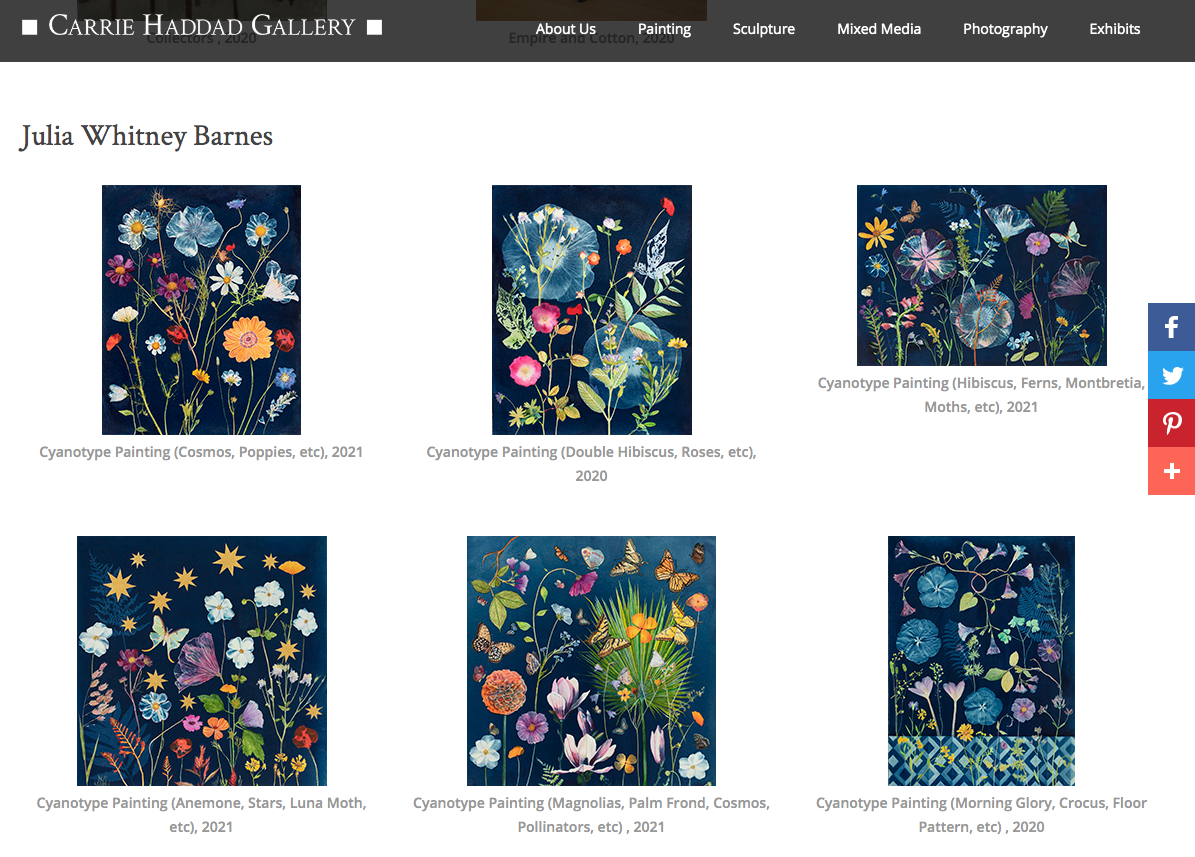
New body of work featured in "Bold Little Beauty"
"Bold Little Beauty" at Carrie Haddad Gallery
Julia Whitney Barnes, Linda Newman Boughton, Sue Bryan, Shawn Dulaney, Susan Hope Fogel and Betsy Weis
Opening Reception: Saturday, April 9th, 5-7pm
April 6, 2022 through May 30, 2022
Carrie Haddad Gallery is pleased to present “Bold Little Beauty”, an exhibit of painting and drawing by gallery artists Julia Whitney Barnes, Linda Newman Boughton, Sue Bryan, Shawn Dulaney, Susan Hope Fogel and photography by Betsy Weis. The exhibit will be on view April 6 – May 30th with an opening reception for the artists on Saturday, April 9th from 5-7pm. All are encouraged and welcome to attend. Masks are optional but recommended.
In her poem “May Flower”, the poet Emily Dickinson uses simple yet powerful language to convey how a small, pink flower, “covert in April, candid in May”, embodies humanity’s relationship with nature and time. With a single line, Dickinson elevates the physical to the symbolic, reminding us that we all have access to spring, new life, beauty, and unity with the natural world since it resides in one’s soul. The final stanza imparts that nature is “bedecked” by such “bold little beauties”; it is made up of tiny different lives, all of which are valuable and beautiful. And yet we are all destined to bloom, fade and die; to perpetuate a cycle that is at once hopeful and tragic. The work of these six artists is the visual manifestation of Dickinson’s sentiment as we consider our relationship with not only the natural world, but also with humanity. These artists are unified by an open-hearted approach to synthesizing their connectedness to nature, all the while exploring its complexities and embracing its simplicities.
Viewing Shawn Dulaney’s paintings could be likened to the experience of taking profoundly deep breaths; slowly inhaling to create an inner expansion followed by the expression of air into the abyss. Dulaney was raised on a plateau in Colorado where she lived under the constant influence of the vast sky. Its uninterrupted horizon and dramatic sunsets have served as continual source material for the abstractions in her work. Using handmade paints consisting of acrylic and powdered pigments, she achieves a wide range of saturations and transparencies on a surface of Venetian plaster. This unique combination creates the perfectly tinted veil through which to enter each painting. For the first time, Dulaney will also exhibit select watercolors alongside her larger paintings. She recalls that watercolor was the first paint she used as a child, and the medium itself feels like atmosphere. The push and pull of the heavier, watery pigments against the lighter ones can create starburst pools she refers to as “little gifts that happen that you can’t plan.” A working artist for over four decades, Dulaney’s paintings have been exhibited widely and can be found in extensive public and private collections including the Hunterdon Museum of Art in New Jersey. Her work has been reviewed in ArtNews, and The New York Times, and featured in Parabola Magazine and New American Paintings.
The smokey silhouette of a landscape rendered in charcoal is how Sue Bryan first commands your attention. A velvety rich, monochromatic palette of tonal greys are captivating from a distance and inviting in proximity. Bryan’s ability to distill the land’s complexities while preserving interest and integrity on a four-inch surface remains unparalleled. In her most recent drawing titled Sprig, 2021, 36 x 48 inches, she leaps onto a much larger surface where she exercises skillful drawing techniques to merge intricate detail with a broader interpretation of light and shadow. Other works are tinged with watercolor, a distinguishing touch that further endows the work with warmth and whimsy. Sue Bryan’s artistic practice repeatedly acknowledges the edges of knowing and celebrates the wonders of the unknown. A native of Ireland, Sue Bryan is primarily a self-taught artist. Her work has been selected for numerous juried exhibitions in the US and abroad, and she currently has representation in France and England. We are delighted to have been exhibiting her drawings in the gallery since 2015.
Susan Hope Fogel describes her paintings in watercolor as “an alternating dance of construction and deconstruction until the form is there, yet not defined in the traditional sense.” Scenes are pieced together, as if from a memory; convening outdoors for a summer evening concert; people-watching in Central Park; long, summer afternoons on the beach. Her work with its many layers of paint, drips, and splatters, achieves a mood that is activated by how she paints the light. Figures are prevalent in Fogel’s landscapes and urban scenes. She enriches these silhouettes with personality and character simply by capturing their posture, pose, shape and size. Fogel studied at The New York Academy of Art, The Art Student’s League, The National Academy of Design, and landscape painting at The Ridgewood Art Institute. The artist lives and works in Warwick, NY.
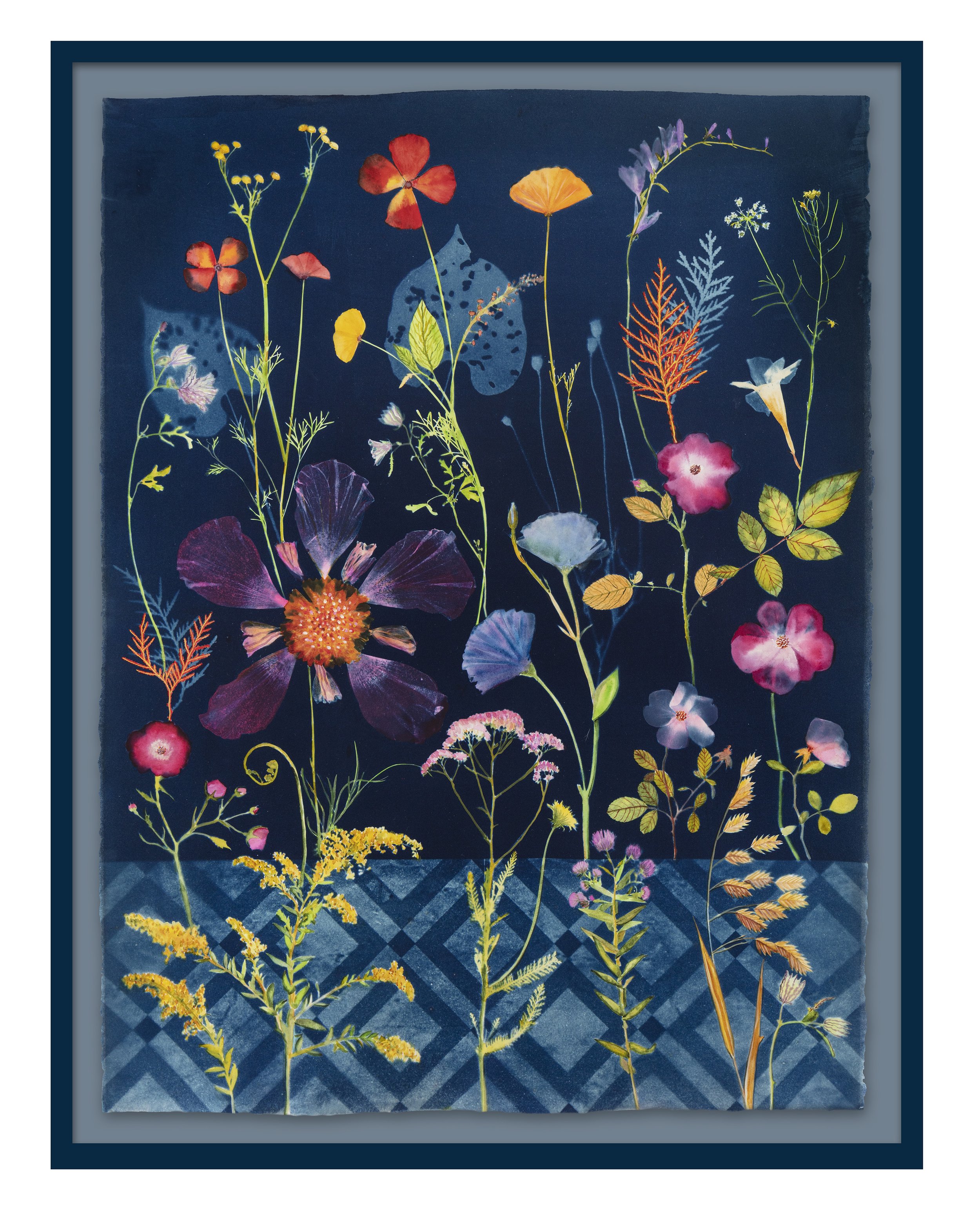
Julia Whitney Barnes has a uniquely tender treatment of the botanicals that inform her painting. Each composition starts as a blue and white cyanotype on watercolor paper. The ghostly silhouettes of arranged cut flowers, leaves and weeds are transferred to the paper using this camera-less technique, creating the foundation for what is then hand painted using gouache, watercolor, ink, and metallic paints. The composition experiences a sublime transformation in this stage. In her new series of Gold Cyanotype Paintings, a mandala formation emerges, evoking the rare and complex Shaker Gift Drawings of the mid-1800s. Whitney Barnes’ vision follows through to the final presentation with carefully constructed frames that encase these unique paintings, providing an environment for where they may exist akin to a specimen at a natural history museum. Julia Whitney Barnes is working towards “Planting Utopia” a three part site-specific exhibition opening this summer at the Shaker Heritage Site and the Albany International Airport. The show will be accompanied by a book to be released in August.
Some might struggle to associate impressionist painting and drawing with a ballpoint pen medium, but one of Linda Newman Boughton’s opulent landscape drawings in signature blue ink is a masterclass in the art of immediacy and movement. From a wild and tangled web of lines emerges identifiable forms, such as a complex root system or a bushy canopy of leaves. The work itself feels kinetic; millions of mark makings vibrate with an energy that stems from a sacred connection to nature. In recent months, Boughton has shifted to a larger scale by which to take an even deeper dive into this vast world of connectivity. This exhibit will present two drawings that are her largest landscapes to date; compositions that balance the density of detail with lightness of space. A self-taught artist, Boughton has worked as the head of scenic departments in the film and television industry in Los Angeles and has been represented by the gallery since 2015.
Betsy Weis has a distinct way of photographing that says as much about what is right in front of her as what is excluded from the frame. She is guided by weather, light and mood to discover moments and perspectives of transience. A resident of New York City, Weis travels extensively to leave the city grid and bask in nature. During the pandemic, her mobility was restricted and like so many of us, she turned to local pursuits. Her terrace and the stationery potted plants became a renewed source of interest and soon became subjects. This exhibit will include expansive images in black and white of leaves gently suspended in an open sky, suggestive that we are looking up from below where we stand in a concrete Arcadia. Betsy Weis received her MA in Painting from New York University and has been exhibiting with the gallery since 1997.
Carrie Haddad Gallery
622 Warren Street, Hudson, NY 12534
518-828-1915 info@carriehaddadgallery.com
Open Daily: 11 am to 5 pm
Except Tuesdays by appointment only

Julia Whitney Barnes
Cyanotype Painting (Hellebore, Fritillaria, Pollinators, Tondo), 2021
23" X 23" paper size
29” x 29” inches framed
watercolor, gouache, and cyanotype on Cotton Arches Paper
Four works featured in "Sans Toi" April 6–30, at Equity Gallery, 245 Broome Street, NYC
Equity Gallery is pleased to announce Sans Toi, a group exhibition featuring works by Sarah Kurz, Iris Lan, Kristina Libby, and Julia Whitney Barnes. The exhibition is curated by Melinda Wang, an independent curator and a former executive director of New York Artists Equity and Equity Gallery. It will be on view from April 6-30, 2022, with a public opening reception on Thursday, April 7, 6-8pm.
Equity Gallery is pleased to announce Sans Toi, a group exhibition featuring works by Sarah Kurz, Iris Lan, Kristina Libby, and Julia Whitney Barnes. The exhibition is curated by Melinda Wang, an independent curator and a former executive director of New York Artists Equity and Equity Gallery. It will be on view from April 6-30, 2022, with a public opening reception on Thursday, April 7, 6-8pm.
Anticipation. What ifs. Anxiety. Time suspended. Two years into a global pandemic and now living under the dark clouds of war, we’re caught in a liminal space of waiting for what’s next while confronting our own mortality. The artists in the exhibition bring us new perspectives of memento mori and the imbuing of beauty into reminders of the inevitability of death. Through painting, film, sculpture and music, the works help us process the world around us, understand the passage of time and perhaps conjure a call to action.
Sarah Kurz’s paintings investigate stream-of-consciousness moments when memory and reality coalesce. Capturing the feeling of being caught in the moment, and the mystery of whether a visual memory is imagined or real, these paintings create a swirl of thoughts about longing, beauty, death and the passage of time. Iris Lan explores litanies as memento mori. Her composition, “Prelude: Litany,” recalls petitionary prayer and the imagery of snow and dust as a meditation on Ecclesiastes (“For everything there is a season”). She performs Jehan Alain’s ardent response to a time of distress and Maurice Durufle’s tribute to Alain and his last moments as he faced death in World War II. Kristina Libby’s works are an invitation to process grief by connecting with one another. “Heartbleed'' honors the lives lost during the pandemic, with each fallen rose petal representing one American we have lost and becoming a storm of red as we recall our collective trauma. Her bone and floral sculptures remind us of the mutualistic relationship among the organic, the ephemeral and the eternal. The beauty of Julia Whitney Barnes’s painted cyanotype flower works is immediately apparent with their saturated colors and engaging composition. Upon closer look, the flowers are ghost-like -- capturing both “light” and “death” as the cut flowers will soon be discarded. Only the flowers’ images remain; they are a permanent symbol of the subjects’ impermanence.
Each artist gives us layers of emotions and contradictions to examine and understand, while also offering us the opportunity to reflect. “Beauty” is transformed from physical beauty to the beauty of a deeper understanding of our own mortality. A memento mori illuminates and inspires. How will you live your life today?
“Sans Toi” is the theme song of Agnes Varda’s film, “Cleo from 5 to 7,” a memento mori that explores beauty, authenticity, existentialism and French feminism through the vehicle of liminal space.

New York Artists Equity Association Inc.
245 Broome Street
New York, NY 10002
Tel: +1 (931) 410-0020
Email: info@nyartistsequity.org
Gallery Hours: Wednesday to Saturday, 12 PM - 6 PM
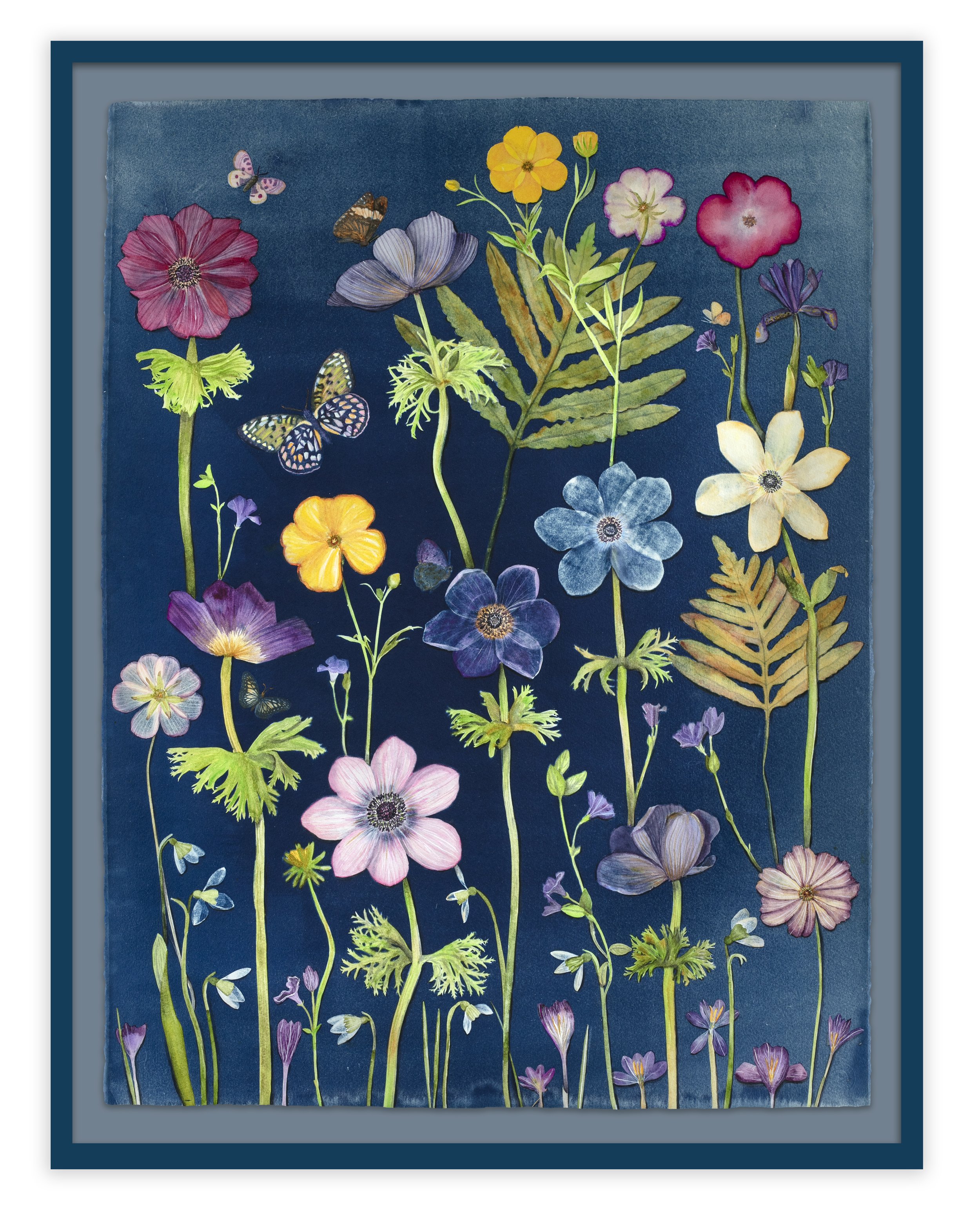
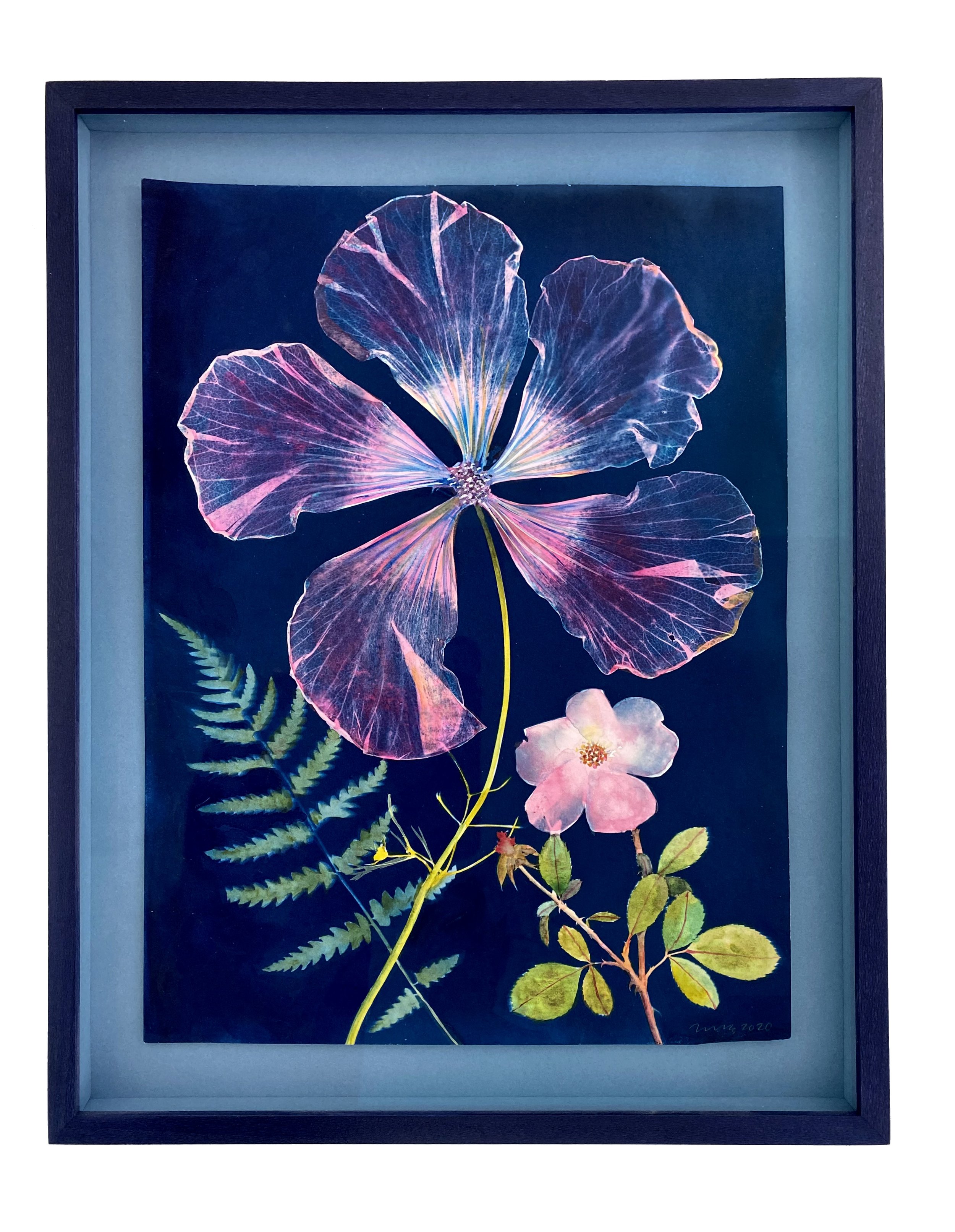
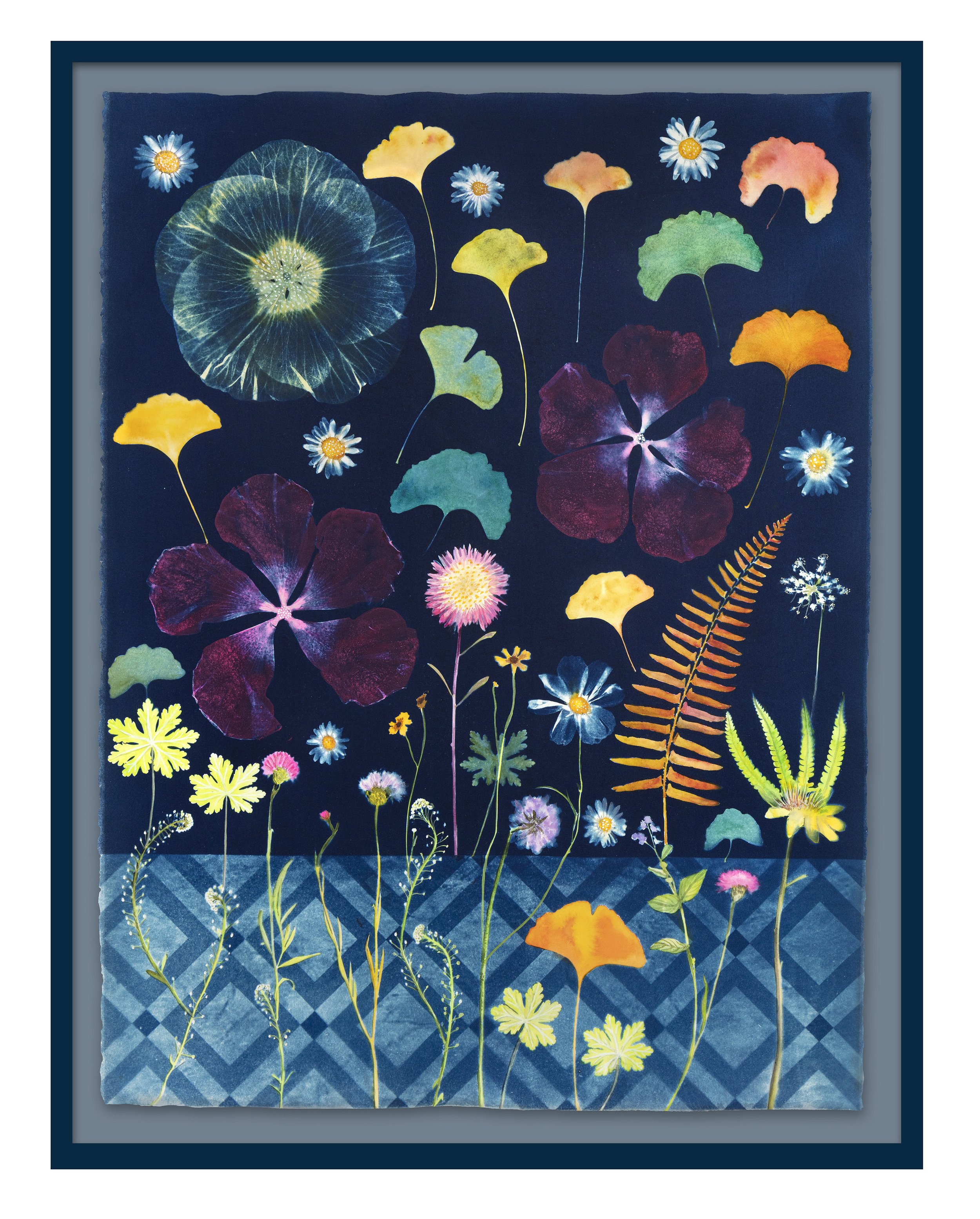
American Art Collector Magazine Feature
Happy to have my included in a special section about botanical art.

Profile published in Hudson Valley Magazine

Multimedia artist Julia Whitney Barnes creates masterpieces using cyanotype techniques and unique materials like plants and bricks.
Art seemed inevitable for Julia Whitney Barnes. The colors of the Hudson Valley have inspired her since she was a child.
“I can’t imagine my life where I am anything but an artist,” Whitney Barnes says.

Julia Whitney Barnes
Whitney Barnes started her career as early as high school, when she practiced screen printing, making fabrics, and designing clothing. Being a part of a family where her father is a poet and her mother a lifelong musician, creativity has always been encouraged. By the time she moved to New York City to attend Parsons School of Design, she soon found a new love for art. She avoids constraints in her work, experimenting with a variety of new techniques and mediums, including watercolors and oil paintings, which she still uses today.
It seems simple to start one project, finish it, and move on to the next, but that’s not how most artists operate. In a given week, Whitney Barnes works on oil paintings, stained glass, and installations. She enriches all of her projects with a piece of the Hudson Valley.
“I always had an interest in plants,” Whitney Barnes says. “When I moved to the Hudson Valley, I wanted something that felt more intimate. So, I started focusing on the plants around me.”
Although cyanotype has become one of Whitney Barnes’ most dominant techniques, she only started delving into the art form two years ago. Cyanotype is a photographic printing process that produces a cyan-blue print. Astronomer John Herschel originated the technique in 1842. It was used widely throughout history to make blueprints and art.
When creating cyanotypes, Whitney Barnes typically uses local flora from the Hudson Valley. Walking into her backyard, she will select ferns, poppies, petunias, daffodils, and a variety of other plant species. Next, she will press them for inspiration and use in her projects. She also receives plants from her neighbors and has been collaborating with two historic gardens, Locust Grove in Poughkeepsie and the Shaker Heritage Site in Albany.
In her collection, Whitney Barnes estimates that she currently has thousands of plants. She keeps the plants in her studio to press and examine. After looking at the different plant species, she picks different ones out to use in her current body of work.
“I carefully arrange elaborate cyanotype compositions at night and utilize long exposures under natural or UV light to create the prints,” Whitney Barnes explains.“Once the unique cyan imagery is fused, I meticulously paint the exposed watercolor paper with multiple layers of watercolor, ink, and gouache.”
Gouache is a method of painting that is similar to watercolors. However, the main difference is that gouache is more opaque. White paper and drawings underneath typically show through when a layer of watercolor is applied. When using a layer of gouache, the paper will hardly show through.

Pieces by Julia Whitney Barnes on display at Carrie Haddad Gallery in Hudson
Working on many cyanotypes at once, Whitney Barnes rotates them depending on her inspiration at the time. Many of her cyanotypes are blue and white, which is traditional for the technique. She also creates some with gold and toned tints, and others with full color.
Starting last year, Whitney Barnes began creating prints of her cyanotypes after many people showed interest in purchasing her work. The prints are labor-intensive, but she enjoys the intimate aspect of sending her work to others. With every print sold, she writes the person a handwritten letter to make her art more personal.
She completes most of her work in the studio at night, after she puts her children to sleep.
“I love to come and see what I have done before I go to sleep,” Whitney Barnes says. “I will come up at midnight and paint for another 30 minutes.”
Converting her attic into an art studio, Julia Whitney Barnes embraces what she has. Since her husband is also an artist, he works in the basement studio downstairs. The couple reserves the two main floors of their Hudson Valley home for living. It helps offer a good work-life balance.
Although her home studio doesn’t have high ceilings like she was used to in Brooklyn, it features two skylights. The natural light allows Whitney Barnes to be present in her work and comfortable in the space. Although her home studio isn’t large, it is her own. Renovating the studio to uniquely cater to what she wants has been part of what makes the space so special.
Moving from Brooklyn to the Hudson Valley allowed Whitney Barnes to immerse herself in projects that had previously been put on the back-burner. For about a decade now, she has been working on a project called the Hudson River of Bricks.
“When living in Brooklyn, I noticed that brick edifices were demolished and carted off to points unknown,” Whitney Barnes says. “I began collecting bricks from destroyed buildings as reference images. Once I observed the variety in ‘stamps,’ I discovered that the bricks were made from Hudson River clay.”
The installations created by Whitney Barnes bring attention to the history of bricks made in the Hudson Valley River area. For her installations, she is creating scale versions of the Hudson River by using bricks from more than 250 brickyards. Each brick has a unique stamp marking.

Installation at the Trolley Barn in Poughkeepsie
For one of her installations, she glazed one brick from each brickyard in a range of green and blues hues to represent the Hudson River’s colors as it reflects the sky. Whitney Barnes cleaned each brick and then painted the brickyard name and location on the side in the underglaze. Next, she put the bricks in a modern kiln. After that, she glazes the bricks and fires them one more time before they sit for a week to avoid cracking.
“In the largest version of the installation, each glazed brick is put in the geographic location along the sculpted river where its brickyard existed,” Whitney Barnes explains.
Another version of the installation includes glazed bricks in alphabetical order to show variations brick makers used over time. With every brickyard, there are slight differences in the fonts, depth of bricks, and clay body colors.
The ultimate goal for Whitney Barnes is to permanently install the Hudson River of Bricks project somewhere in New York State. Before she does that, she wants to have an example of at least one brick from every brickyard that existed along the Hudson River. The 150-year-old bricks pose some challenges. For instance, Barnes only uses stamped bricks in the project.
“The progress for my installation has slowed down because the more bricks I have, the harder it is to collect the ones I don’t have,” Whitney Barnes says. “I think I’m up to almost 300 brickyards and I have thousands of stamped bricks.”
While still working on the Hudson River of Bricks installation, she is also busy with other projects in the area. NYSCA recently awarded Julia Whitney Barnes with an artist’s fellowship grant for her project “Planting Utopia.” Check out the project by visiting the Shaker Heritage Site in Albany and at the Albany International Airport in June.
For “Planting Utopia,” Whitney Barnes has collected specimens from over 150 plants growing in the herb garden at Shaker Heritage Society. The site is the first Shaker settlement in America. The herb garden serves as inspiration for a series of her artworks that will be presented inside and mounted on the exterior of the 1856 Brick Drying House at the Shaker Heritage Site.
Whitney Barnes is also creating an herbarium from the garden. She mounts each plant and compiles them into a book along with historic imagery once the project is complete. Whitney Barnes’ work will be on display at the Shaker Heritage Site for about one year and at the Albany International Airport for three years.
Starting on April 6, a large collection of her work will be available for in-person viewing at the Carrie Haddad Gallery in Hudson. There will be an opening reception on April 9 from 5 to 7 p.m., and her works, such as cyanotypes, paintings, and prints, will be on display in the gallery through the entirety of April and May.
“I want the content of my work to be a powerful experience, not only because of the historical moment in which they were made, but in that the process speaks to a kind of gutting and reconstituting,” Whitney Barnes explains. “The final work isn’t the object, but instead, a record of my will to bring it back.”
Awarded $10K New York State Council on the Arts Support for Artists Grant

I am thrilled to share that I was awarded a $10,000 grant for my project “Planting Utopia” that will be at the Shaker Heritage Society starting in summer 2022. There will also be a partnering installation at the Albany International Airport on view from 2022 through 2025.

Julia Whitney Barnes is the recipient of a 2022 NYSCA Support for Artists Grant
"Select6" at Simon|Garvey NY

Cyanotype Painting (Gold Hibiscus, Cosmos, Ferns, Floor Pattern, etc), 2021
Watercolor, gouache, ink, mica, and cyanotype on cotton Fabriano paper
December 1, 2021 — February 28, 2022
Artsy.net|UWS
Garvey|Simon is pleased to announce Select6, the sixth annual exhibition of artists chosen by director Elizabeth K. Garvey through the gallery’s innovative Review Program.
This year’s ten artists are:
Julia Whitney Barnes, Jimmy Fike, Anne Finkelstein, Jenifer Kent, Lori Larusso, Gwyneth Leech, Claire McConaughy, Debra Ramsay, Linda Schmidt, and Charles Yoder.
JULIA WHITNEY BARNES
Julia Whitney Barnes uses the power of natural light to craft her floral cyanotypes. She is indiscriminate in selecting specimen, gathering everything from weeds to cultivated flowers. After posing and drying her subjects, Barnes builds her compositions on the surface of her photo-sensitive paper. Barnes also integrates watercolor and digitally-rendered negatives into her ethereal scenes. The final product is a mélange of techniques, shapes, and colors that is at once familiar and extraordinary. Julia Whitney Barnes has exhibited widely in the United States and internationally. She was awarded fellowships from New York State Council on the Arts administered through Arts Mid-Hudson, Lower Manhattan Cultural Council, Abbey Memorial Fund for Mural Painting/National Academy of Fine Arts, and the Gowanus Public Art Initiative, among others.
Garvey|Simon established the Review Program in 2016 to open a dialogue between artists and galleries, a practice that has long been anathema to gallery orthodoxy. Neither the past practice of artists drowning galleries in heaps of slides nor today’s avalanche of emails is beneficial to either gallery or artist. Garvey believes that artists “need to have a working platform to engage with dealers who otherwise might not see their work.” In the multi-tiered program, artists must pay an administrative fee for their work to be reviewed. “We want artists to think before they submit and be sure their work is appropriate for our program – the small fee puts some skin in the game and detracts from artists sending generic, mass submissions.” Finalists are given a private meeting with the gallery to consider their work for the exhibition. Garvey|Simon has cultivated successful partnerships with artists Margot Glass, Eileen Murphy, Karl Hartman, Kit Warren, Robert Stuart, Sung Won Yun, and Joshua Flint through the Select program.
For further information, to see more images, or to schedule an in-person or Zoom viewing, please visit Garvey Simon or contact Elizabeth Garvey at liz@garveysimon.com or 917-796-2146.
Interview with "Artist/Mother Podcast"
It was such a pleasure talking with New York City-based artist, Julia Whitney Barnes, in this interview about being flexible in your art practice, experimenting with new processes, and creating boundaries to play within. By relinquishing the more traditional and time-consuming aspects of her oil-painting process, Julia was able to retain the creativity of blending colors and creating compositions, and let go of the tedious underpainting process – which, in her case, she achieves through cyanotypes. She also discusses a big income-maker for her: prints! Although initially she was resistant to the idea of selling prints of her work, she found quality materials that worked well, and met the challenge head on.
So happy to share this interview that just came out with the Artist/Mother podcast. Thank you Kaylan Buteyn!
https://artistmotherpodcast.com/podcast/105-following-your-whims-building-income-through-print-sales-with-julia-whitney-barnes/

It was such a pleasure talking with New York City-based artist, Julia Whitney Barnes, in this interview about being flexible in your art practice, experimenting with new processes, and creating boundaries to play within. By relinquishing the more traditional and time-consuming aspects of her oil-painting process, Julia was able to retain the creativity of blending colors and creating compositions, and let go of the tedious underpainting process – which, in her case, she achieves through cyanotypes. She also discusses a big income-maker for her: prints! Although initially she was resistant to the idea of selling prints of her work, she found quality materials that worked well, and met the challenge head on.
In addition to her water-colored cyanotypes, Julia also makes oil paintings, ceramic sculptures, murals, and site-specific installations. She has exhibited widely in the United States and internationally. She was awarded fellowships from New York State Council on the Arts administered through Arts Mid-Hudson, Lower Manhattan Cultural Council, Abbey Memorial Fund for Mural Painting/National Academy of Fine Arts, and the Gowanus Public Art Initiative, among others. In her “Hudson River of Bricks” installation, she mirrors the scale of the Hudson River with old handmade bricks from Hudson River Valley brickyards – their varied colors and imprinted names on each brick a view into the past.
As we delve more deeply into her process and artist/mother life, we look at how her upbringing shaped her artistic and creative path. Born on a kitchen floor in Vermont during her aunt’s birthday party, and then growing up in a very musical and creative family (her father being a poet and her mother having degrees in Psychology, Teaching, and Divinity), Julia’s path to becoming an artist was natural and encouraged. Even though she entered Parsons School of Art & Design as a declared Fashion and Art major, she quickly learned that she preferred the fine arts route, and threw herself into oil painting. It wasn’t until she had children that she expanded her art practice into photography – namely, cyanotypes.
The cyanotype process affords Julia the perfect mix of freedom, play, and boundaries. She enjoys the immediacy of creating her floral compositions with the cyanotype process (often times involving her young children), and also revels in the joy of watercolors – the way she can mix a color on her palette, leave it for a month or longer, and with just the simple addition of water, return it to its full potential. We also discuss how these same thought processes apply to the artist/mother life so perfectly: the balance between letting go and at the same creating boundaries reveals a calm and a sense of play that is so satisfying and necessary. Through this very specific art-making, Julia delightfully forges new territory and nurtures these new processes into fully realized works – much as we all nurture and shape our children.
Final Five:
Biggest Art Crush: Betty Woodman and Inka Essenhigh
Dream Trip: Holland and/or Portugal
Film or book: Wizard of Oz
Favorite meal: Salmon with cous-cous and veggies that husband makes
Shout-out: Husband, mom, sister
To see more of Julia’s work please visit her website and follow her on IG @juliawhitneybarnes
The Artist/Mother podcast is created and hosted by Kaylan Buteyn. You can see more of Kaylan’s work on her website or connect with her on Instagram @kaylanbuteyn
"Propagation" at Kenise Barnes Fine Art
I am pleased to announce that my work will be featured in this show. with KBFA in Kent, CT.
A celebration of spring (at last!) with artwork based on botany and pollinators including artists Julia Whitney Barnes, Nancy Blum, Peter Hamlin, Catherine Latson, Julie Maren, Joseph Scheer.
The show is on view from May 8 - June 20.
7 FULLING LANE, KENT, CT 06757
860 592 0220KENISE@KBFA.COM
hours: Thursday - Saturday 11:00 - 5:30, Sunday 12 - 4:00 and by appointment
BECAUSE ART IS ESSENTIAL
With a focus on unique and exceptional contemporary art Kenise Barnes Fine Art represents more than 50 emerging and mid-career artists working in all media. We have a wide selection of paintings, drawings, photography and sculpture as well as consulting services and collecting advice for the burgeoning to the seasoned collector. In addition to our curated exhibitions that change every six weeks we maintain a large inventory of work from our artists’ studios in our on-site warehouses. As a professional art consulting firm, we also source work from our wide network of artist’s studios, galleries, and auction houses. We work extensively with architects, interior designers, art advisors and home owners to find the perfect fit whether it is an entire collection or one special piece.
Kenise Barnes Fine Art opened in 1994 in Larchmont, NY and in May 2019 added a second location in the stunning Kent Barns complex in Kent, CT. In Spring 2021 the gallery expanded its presence in Kent by annexing a second buidling and now is doing business in our two barns in the beautiful Litchfield Hills and on our internet platforms (KBFA.com. ARTSY.com and 1st Dibs.com).

Interview with "I Like Your Work"

I’m so pleased to share this interview with “I Like Your Work” that was published on Friday, April 23, 2021.
Artist Julia Whitney Barnes
Julia Whitney Barnes in an artist living in the Hudson Valley who works in a variety of media from cyanotypes, watercolor, oil paintings, ceramic sculptures, murals, drawings, etchings, and site-specific installations. She has exhibited widely in the United States. She was awarded fellowships from New York State Council on the Arts administered through Arts Mid-Hudson, Lower Manhattan Cultural Council, Abbey Memorial Fund for Mural Painting/National Academy of Fine Arts, and the Gowanus Public Art Initiative, among others.
Born in Newbury, VT, Julia Whitney Barnes spent two decades in Brooklyn, before moving to Poughkeepsie, NY. She received her BFA from Parsons School of Design and her MFA from Hunter College. Whitney Barnes has created site-specific installations at Arts Brookfield/New York, NY and Brooklyn, NY, the Wilderstein
Sculpture Biennial, Rhinebeck, NY; The Trolley Barn/Fall Kill Creative Works, Poughkeepsie, NY; GlenLily Grounds, Newburgh, NY; ArtsWestchester, White Plains, NY; Gowanus Public Arts Initiative, Brooklyn, NY; Space All Over/Fjellerup Bund i Bund & Grund, Fjellerup, Denmark; Lower Manhattan Cultural Council/Sirovitch Senior Center, New York, NY; Brooklyn School of Inquiry, Brooklyn, NY; New York City Department of Transportation, New York, NY; and Figment Sculpture Garden, Governors Island, NY and among other locations.
1: Tell us a little bit about yourself and your background in the arts.
I was born on an L.L. Bean camping pad on the kitchen floor of a Victorian house in Newbury, Vermont. This largely sums up my childhood. I often work on the floor of my studio and have done many site-specific floor paintings; I’ve wondered if perhaps I have a natural affinity for the floor due to my auspicious arrival.
At the time, my parents had a small business buying and selling antique cars and stringed instruments. My mother’s background is in theology and spirituality and my father is a poet. My parents were part of the 1970s back-to-the-land movement and we moved around a lot for various reasons. I lived all over New England as a child and for high school attended a fine arts program at the Norwich Free Academy in Norwich, CT. It has a unique educational model, and has a museum on the campus, plus an area of rotating exhibitions.
I moved to NYC to attend Parsons School of Design for my BFA and then went on to earn an MFA from Hunter College. After 18 years in the city (mostly in Brooklyn), my photographer husband, Sean Hemmerle, and I moved to Poughkeepsie in 2015. We have a daughter who is five, a son who is almost three and a house that is over a hundred years old.
Pre-motherhood, I spent a few years focused on traveling to various parts of the world and those travels were formative for my future art making. Some of the work that resonated most strongly with me were mosaics made in the last 2,500 years. Being in very different landscapes, like that of Iceland and Greece, also made a lasting impression and I’m grateful I was able to experience so much before travel became more complex. I have always enjoyed splitting my time between making studio work and public art. My murals and installations have been installed in various indoor and outdoor locations in the United States and Europe. One of the projects I have dreamed of doing since I was in undergrad twenty years ago is to design an immersive NYC subway station mosaic. Each year I feel that I am a bit closer to making that possible.
2: What kind of work are you currently making?
Since we moved to the Hudson Valley from Brooklyn six years ago, my work has been much more focused on the natural world. For the past year I’ve been focused on making works on paper that combine watercolor, gouache, ink and cyanotype. The process feels like a satisfying marriage of painting, printmaking, collage, digital media and camera-less photography. As I’ve worked in a myriad of mediums over the past two decades, this current body of work is a culmination of a lot of ideas. Part of my process is growing and pressing plants that I manipulate in the photogram process, and also photograph for source imagery.
I combine several species into single compositions, often to the point where the species of plants depicted are open to interpretation. I create unique blue and white cyanotype prints on thick sheets of cotton paper and then paint in many layers of watercolor, gouache and ink.
I am most interested in creating objects that feel both beautiful and mysterious. I want each painting to be familiar yet slightly outside of time. These works symbolize resilience to me. I want the content of the work to be a powerful experience, not only because of the historical moment in which they were made, but in that the process speaks to a kind of gutting and reconstituting. There's an object, then a ghost of the object, and then the reassertion of the object. The final work isn't the object, but instead, a record of my will to bring it back. And that is more satisfying, more hopeful, than had the original object appeared back on the paper.
3: What is a day like in the studio for you?
I work in my studio every day. Even if it’s only for 15 minutes, that consistency feels important to stay in the flow. My studio is in the attic of our hundred year old house. After five years of various projects up here, we finished the space last winter and I have been super productive since then. A third of my studio has been taken over by my children but that allows me to spend more time in my studio so it was worth the loss of space. It’s fun to see what they create (though they make HUGE messes).
I carefully arrange elaborate cyanotype compositions at night and utilize long exposures under natural or UV light to create the prints. I also create digital renderings in Photoshop and Illustrator and turn them into negatives to use in this work. Once the unique cyan imagery is fused, I meticulously paint the exposed watercolor paper with multiple layers of watercolor, ink and gouache.
I work on many pieces at once and rotate them out of sight in my large flat files when I’m feeling frustrated or need a change of pace. Some of my cyanotype paintings are all blue and white and some are painted in full color, so I like to go back and forth working with these different palettes. I do my most concentrated work at night once my children are in bed. I’m naturally a night owl, but I am looking forward to having more daylight hours of studio time once outside childcare and in-person school are happening again. I include my children in some studio activities like collecting, photographing, shaping and pressing plants, and also making color studies while they paint or draw. Experiencing the world with them is equally inspiring and distracting.
4: What are you looking at right now and/or reading?
I’m collaborating with the Shaker Historic Site and Albany International Airport and am reading “The Shaker’s Private Art,” a book about gift drawings plus skimming through a few other books on Shaker culture. The Shakers sold the land to the county to facilitate the project and when it opened in 1928 it was America’s first municipal airport. I am excited to cross-pollinate the audience that experiences both places. I will be collecting specimens from the historic Shaker garden, which was long used to grow medicinal herbs and I have been studying the uses for each plant. The signage on each plant includes its common name, Latin name and the purpose for which it was grown.
I also read many books on flowers and art. A few recent favorites that are nearby include, “Say it with Flowers, Viennese Flower Painting from Waldmüller to Klimt,” “Flower: Exploring the World in Bloom,” and “Frances Palmer, Life in the Studio.” Palmer’s book has photos of her fantastic ceramics and garden and also has recipes in the back. Flipping through it always makes me hungry, and I want to grow gorgeous plants to arrange in porcelain vases.
5: Where can we find more of your work?
https://www.juliawhitneybarnes.com https://www.instagram.com/juliawhitneybarnes/
https://www.tiktok.com/@juliawhitneybarnes
I’m bad at saying no and somehow have five shows opening in May…
I’m excited about are my upcoming show, “Propagation” with Kenise Barnes Fine Art, on view from May 8 – June 20 in Kent, CT. The show is at the gallery’s new space along with five other artists whose work I love. I also have a triptych of cyanotype landscape paintings in the exhibition “Sunrise Sunset” at the Albany International Airport from May 15 – August 30 in Albany, NY. The gallery is open to the public and does not require going through airport security. One of my cyanotype paintings will be included in “Together apART: Creating During COVID” at ArtsWestchester from May 7 – August 1 in White Plains, NY. You can also see my work in “Continuum” in the Perspective Gallery, Whitney Center (A program of Ely Center of Contemporary Art) from May 15 – September 1 in Hamden, CT. Four of my small works are included in “Flourish” from May 1 – 31 at Lark & Key Gallery in Charlotte, NC.
My work is also represented by Carrie Haddad Gallery in Hudson, NY, where I just had a show of a dozen works this spring.
30th Anniversary exhibition at Carrie Haddad Gallery
I am thrilled to have a dozen works at Carrie Haddad Gallery in Hudson, NY to help celebrate the 30th Anniversary of this prestigious gallery. Click here to see my work available through the gallery.
Julia Whitney Barnes, Samantha French, Ruth Geneslaw, Hue Thi Hoffmaster, Nancy Egol Nikkal, Annika Tucksmith, K. Velis Turan, & Judith Wyer
February 17, 2021 through April 11, 2021
Carrie Haddad opened the first art gallery on Warren St. in Hudson, NY in 1991 with a mission to showcase local artists of the region. Thirty years later, that mission remains at the core of the gallery’s operations as we continue to host seven group exhibits a year with a dedicated roster of artists, some of which have shown with Haddad since the beginning. In celebration of the gallery’s 30th anniversary, we are pleased to present an Invitational Exhibit, on view February 17 – April 11, which will highlight our selections from an open call put out at the end of last year. Out of over 200 submissions, 7 artists were chosen: Julia Whitney Barnes, Samantha French, Ruth Geneslaw, Hue Thi Hoffmaster, Nancy Egol Nikkal, Annika Tucksmith, K. Velis Turan and Judith Wyer. Working in a range of media and genres, their work aligns with the variety of creative talent shown at the gallery for three decades. When we consider how dramatically these white walls are transformed every seven weeks, this exhibit will be no exception. Openings are suspended due to Covid-19, but the gallery remains open to the public daily from 11-5 (except Tuesdays are by appointment only).
Carrie Haddad Gallery
622 Warren Street
Hudson, NY 12534
518-828-1915
info@carriehaddadgallery.com
Open Daily: 11 am to 5 pm
Except Tuesdays by appointment only
About the gallery:
Established in 1991 as the first fine art gallery in Hudson, NY, Carrie Haddad Gallery represents professionally committed artists as well as emerging talent specializing in all types of painting, both large and small sculpture, works on paper and a variety of techniques in photography. The majority of our inventory consists of both figurative and non-representational contemporary artwork. Carrie Haddad also represents several estates of deceased artists influenced by the Post War Art Movement in America c.1935 - 1970s.
Occupying 3000 square feet of exhibition space on Warren Street, the gallery is conveniently located just two hours north of Manhattan. The annual exhibition schedule accommodates 7 exhibits on the main floor as well as a rotating selection of photography displayed on the second floor. Carrie Haddad Gallery offers art consultation services, collaborating with design professionals and architects across the country to procure compelling works for private residences and corporate collections. Our diverse inventory offers solutions to fit a variety of criteria and our team ensures direct and dedicated project management.