"Select6" at Simon|Garvey NY

Cyanotype Painting (Gold Hibiscus, Cosmos, Ferns, Floor Pattern, etc), 2021
Watercolor, gouache, ink, mica, and cyanotype on cotton Fabriano paper
December 1, 2021 — February 28, 2022
Artsy.net|UWS
Garvey|Simon is pleased to announce Select6, the sixth annual exhibition of artists chosen by director Elizabeth K. Garvey through the gallery’s innovative Review Program.
This year’s ten artists are:
Julia Whitney Barnes, Jimmy Fike, Anne Finkelstein, Jenifer Kent, Lori Larusso, Gwyneth Leech, Claire McConaughy, Debra Ramsay, Linda Schmidt, and Charles Yoder.
JULIA WHITNEY BARNES
Julia Whitney Barnes uses the power of natural light to craft her floral cyanotypes. She is indiscriminate in selecting specimen, gathering everything from weeds to cultivated flowers. After posing and drying her subjects, Barnes builds her compositions on the surface of her photo-sensitive paper. Barnes also integrates watercolor and digitally-rendered negatives into her ethereal scenes. The final product is a mélange of techniques, shapes, and colors that is at once familiar and extraordinary. Julia Whitney Barnes has exhibited widely in the United States and internationally. She was awarded fellowships from New York State Council on the Arts administered through Arts Mid-Hudson, Lower Manhattan Cultural Council, Abbey Memorial Fund for Mural Painting/National Academy of Fine Arts, and the Gowanus Public Art Initiative, among others.
Garvey|Simon established the Review Program in 2016 to open a dialogue between artists and galleries, a practice that has long been anathema to gallery orthodoxy. Neither the past practice of artists drowning galleries in heaps of slides nor today’s avalanche of emails is beneficial to either gallery or artist. Garvey believes that artists “need to have a working platform to engage with dealers who otherwise might not see their work.” In the multi-tiered program, artists must pay an administrative fee for their work to be reviewed. “We want artists to think before they submit and be sure their work is appropriate for our program – the small fee puts some skin in the game and detracts from artists sending generic, mass submissions.” Finalists are given a private meeting with the gallery to consider their work for the exhibition. Garvey|Simon has cultivated successful partnerships with artists Margot Glass, Eileen Murphy, Karl Hartman, Kit Warren, Robert Stuart, Sung Won Yun, and Joshua Flint through the Select program.
For further information, to see more images, or to schedule an in-person or Zoom viewing, please visit Garvey Simon or contact Elizabeth Garvey at liz@garveysimon.com or 917-796-2146.
Interview with "Artist/Mother Podcast"
It was such a pleasure talking with New York City-based artist, Julia Whitney Barnes, in this interview about being flexible in your art practice, experimenting with new processes, and creating boundaries to play within. By relinquishing the more traditional and time-consuming aspects of her oil-painting process, Julia was able to retain the creativity of blending colors and creating compositions, and let go of the tedious underpainting process – which, in her case, she achieves through cyanotypes. She also discusses a big income-maker for her: prints! Although initially she was resistant to the idea of selling prints of her work, she found quality materials that worked well, and met the challenge head on.
So happy to share this interview that just came out with the Artist/Mother podcast. Thank you Kaylan Buteyn!
https://artistmotherpodcast.com/podcast/105-following-your-whims-building-income-through-print-sales-with-julia-whitney-barnes/

It was such a pleasure talking with New York City-based artist, Julia Whitney Barnes, in this interview about being flexible in your art practice, experimenting with new processes, and creating boundaries to play within. By relinquishing the more traditional and time-consuming aspects of her oil-painting process, Julia was able to retain the creativity of blending colors and creating compositions, and let go of the tedious underpainting process – which, in her case, she achieves through cyanotypes. She also discusses a big income-maker for her: prints! Although initially she was resistant to the idea of selling prints of her work, she found quality materials that worked well, and met the challenge head on.
In addition to her water-colored cyanotypes, Julia also makes oil paintings, ceramic sculptures, murals, and site-specific installations. She has exhibited widely in the United States and internationally. She was awarded fellowships from New York State Council on the Arts administered through Arts Mid-Hudson, Lower Manhattan Cultural Council, Abbey Memorial Fund for Mural Painting/National Academy of Fine Arts, and the Gowanus Public Art Initiative, among others. In her “Hudson River of Bricks” installation, she mirrors the scale of the Hudson River with old handmade bricks from Hudson River Valley brickyards – their varied colors and imprinted names on each brick a view into the past.
As we delve more deeply into her process and artist/mother life, we look at how her upbringing shaped her artistic and creative path. Born on a kitchen floor in Vermont during her aunt’s birthday party, and then growing up in a very musical and creative family (her father being a poet and her mother having degrees in Psychology, Teaching, and Divinity), Julia’s path to becoming an artist was natural and encouraged. Even though she entered Parsons School of Art & Design as a declared Fashion and Art major, she quickly learned that she preferred the fine arts route, and threw herself into oil painting. It wasn’t until she had children that she expanded her art practice into photography – namely, cyanotypes.
The cyanotype process affords Julia the perfect mix of freedom, play, and boundaries. She enjoys the immediacy of creating her floral compositions with the cyanotype process (often times involving her young children), and also revels in the joy of watercolors – the way she can mix a color on her palette, leave it for a month or longer, and with just the simple addition of water, return it to its full potential. We also discuss how these same thought processes apply to the artist/mother life so perfectly: the balance between letting go and at the same creating boundaries reveals a calm and a sense of play that is so satisfying and necessary. Through this very specific art-making, Julia delightfully forges new territory and nurtures these new processes into fully realized works – much as we all nurture and shape our children.
Final Five:
Biggest Art Crush: Betty Woodman and Inka Essenhigh
Dream Trip: Holland and/or Portugal
Film or book: Wizard of Oz
Favorite meal: Salmon with cous-cous and veggies that husband makes
Shout-out: Husband, mom, sister
To see more of Julia’s work please visit her website and follow her on IG @juliawhitneybarnes
The Artist/Mother podcast is created and hosted by Kaylan Buteyn. You can see more of Kaylan’s work on her website or connect with her on Instagram @kaylanbuteyn
"Propagation" at Kenise Barnes Fine Art
I am pleased to announce that my work will be featured in this show. with KBFA in Kent, CT.
A celebration of spring (at last!) with artwork based on botany and pollinators including artists Julia Whitney Barnes, Nancy Blum, Peter Hamlin, Catherine Latson, Julie Maren, Joseph Scheer.
The show is on view from May 8 - June 20.
7 FULLING LANE, KENT, CT 06757
860 592 0220KENISE@KBFA.COM
hours: Thursday - Saturday 11:00 - 5:30, Sunday 12 - 4:00 and by appointment
BECAUSE ART IS ESSENTIAL
With a focus on unique and exceptional contemporary art Kenise Barnes Fine Art represents more than 50 emerging and mid-career artists working in all media. We have a wide selection of paintings, drawings, photography and sculpture as well as consulting services and collecting advice for the burgeoning to the seasoned collector. In addition to our curated exhibitions that change every six weeks we maintain a large inventory of work from our artists’ studios in our on-site warehouses. As a professional art consulting firm, we also source work from our wide network of artist’s studios, galleries, and auction houses. We work extensively with architects, interior designers, art advisors and home owners to find the perfect fit whether it is an entire collection or one special piece.
Kenise Barnes Fine Art opened in 1994 in Larchmont, NY and in May 2019 added a second location in the stunning Kent Barns complex in Kent, CT. In Spring 2021 the gallery expanded its presence in Kent by annexing a second buidling and now is doing business in our two barns in the beautiful Litchfield Hills and on our internet platforms (KBFA.com. ARTSY.com and 1st Dibs.com).

Interview with "I Like Your Work"

I’m so pleased to share this interview with “I Like Your Work” that was published on Friday, April 23, 2021.
Artist Julia Whitney Barnes
Julia Whitney Barnes in an artist living in the Hudson Valley who works in a variety of media from cyanotypes, watercolor, oil paintings, ceramic sculptures, murals, drawings, etchings, and site-specific installations. She has exhibited widely in the United States. She was awarded fellowships from New York State Council on the Arts administered through Arts Mid-Hudson, Lower Manhattan Cultural Council, Abbey Memorial Fund for Mural Painting/National Academy of Fine Arts, and the Gowanus Public Art Initiative, among others.
Born in Newbury, VT, Julia Whitney Barnes spent two decades in Brooklyn, before moving to Poughkeepsie, NY. She received her BFA from Parsons School of Design and her MFA from Hunter College. Whitney Barnes has created site-specific installations at Arts Brookfield/New York, NY and Brooklyn, NY, the Wilderstein
Sculpture Biennial, Rhinebeck, NY; The Trolley Barn/Fall Kill Creative Works, Poughkeepsie, NY; GlenLily Grounds, Newburgh, NY; ArtsWestchester, White Plains, NY; Gowanus Public Arts Initiative, Brooklyn, NY; Space All Over/Fjellerup Bund i Bund & Grund, Fjellerup, Denmark; Lower Manhattan Cultural Council/Sirovitch Senior Center, New York, NY; Brooklyn School of Inquiry, Brooklyn, NY; New York City Department of Transportation, New York, NY; and Figment Sculpture Garden, Governors Island, NY and among other locations.
1: Tell us a little bit about yourself and your background in the arts.
I was born on an L.L. Bean camping pad on the kitchen floor of a Victorian house in Newbury, Vermont. This largely sums up my childhood. I often work on the floor of my studio and have done many site-specific floor paintings; I’ve wondered if perhaps I have a natural affinity for the floor due to my auspicious arrival.
At the time, my parents had a small business buying and selling antique cars and stringed instruments. My mother’s background is in theology and spirituality and my father is a poet. My parents were part of the 1970s back-to-the-land movement and we moved around a lot for various reasons. I lived all over New England as a child and for high school attended a fine arts program at the Norwich Free Academy in Norwich, CT. It has a unique educational model, and has a museum on the campus, plus an area of rotating exhibitions.
I moved to NYC to attend Parsons School of Design for my BFA and then went on to earn an MFA from Hunter College. After 18 years in the city (mostly in Brooklyn), my photographer husband, Sean Hemmerle, and I moved to Poughkeepsie in 2015. We have a daughter who is five, a son who is almost three and a house that is over a hundred years old.
Pre-motherhood, I spent a few years focused on traveling to various parts of the world and those travels were formative for my future art making. Some of the work that resonated most strongly with me were mosaics made in the last 2,500 years. Being in very different landscapes, like that of Iceland and Greece, also made a lasting impression and I’m grateful I was able to experience so much before travel became more complex. I have always enjoyed splitting my time between making studio work and public art. My murals and installations have been installed in various indoor and outdoor locations in the United States and Europe. One of the projects I have dreamed of doing since I was in undergrad twenty years ago is to design an immersive NYC subway station mosaic. Each year I feel that I am a bit closer to making that possible.
2: What kind of work are you currently making?
Since we moved to the Hudson Valley from Brooklyn six years ago, my work has been much more focused on the natural world. For the past year I’ve been focused on making works on paper that combine watercolor, gouache, ink and cyanotype. The process feels like a satisfying marriage of painting, printmaking, collage, digital media and camera-less photography. As I’ve worked in a myriad of mediums over the past two decades, this current body of work is a culmination of a lot of ideas. Part of my process is growing and pressing plants that I manipulate in the photogram process, and also photograph for source imagery.
I combine several species into single compositions, often to the point where the species of plants depicted are open to interpretation. I create unique blue and white cyanotype prints on thick sheets of cotton paper and then paint in many layers of watercolor, gouache and ink.
I am most interested in creating objects that feel both beautiful and mysterious. I want each painting to be familiar yet slightly outside of time. These works symbolize resilience to me. I want the content of the work to be a powerful experience, not only because of the historical moment in which they were made, but in that the process speaks to a kind of gutting and reconstituting. There's an object, then a ghost of the object, and then the reassertion of the object. The final work isn't the object, but instead, a record of my will to bring it back. And that is more satisfying, more hopeful, than had the original object appeared back on the paper.
3: What is a day like in the studio for you?
I work in my studio every day. Even if it’s only for 15 minutes, that consistency feels important to stay in the flow. My studio is in the attic of our hundred year old house. After five years of various projects up here, we finished the space last winter and I have been super productive since then. A third of my studio has been taken over by my children but that allows me to spend more time in my studio so it was worth the loss of space. It’s fun to see what they create (though they make HUGE messes).
I carefully arrange elaborate cyanotype compositions at night and utilize long exposures under natural or UV light to create the prints. I also create digital renderings in Photoshop and Illustrator and turn them into negatives to use in this work. Once the unique cyan imagery is fused, I meticulously paint the exposed watercolor paper with multiple layers of watercolor, ink and gouache.
I work on many pieces at once and rotate them out of sight in my large flat files when I’m feeling frustrated or need a change of pace. Some of my cyanotype paintings are all blue and white and some are painted in full color, so I like to go back and forth working with these different palettes. I do my most concentrated work at night once my children are in bed. I’m naturally a night owl, but I am looking forward to having more daylight hours of studio time once outside childcare and in-person school are happening again. I include my children in some studio activities like collecting, photographing, shaping and pressing plants, and also making color studies while they paint or draw. Experiencing the world with them is equally inspiring and distracting.
4: What are you looking at right now and/or reading?
I’m collaborating with the Shaker Historic Site and Albany International Airport and am reading “The Shaker’s Private Art,” a book about gift drawings plus skimming through a few other books on Shaker culture. The Shakers sold the land to the county to facilitate the project and when it opened in 1928 it was America’s first municipal airport. I am excited to cross-pollinate the audience that experiences both places. I will be collecting specimens from the historic Shaker garden, which was long used to grow medicinal herbs and I have been studying the uses for each plant. The signage on each plant includes its common name, Latin name and the purpose for which it was grown.
I also read many books on flowers and art. A few recent favorites that are nearby include, “Say it with Flowers, Viennese Flower Painting from Waldmüller to Klimt,” “Flower: Exploring the World in Bloom,” and “Frances Palmer, Life in the Studio.” Palmer’s book has photos of her fantastic ceramics and garden and also has recipes in the back. Flipping through it always makes me hungry, and I want to grow gorgeous plants to arrange in porcelain vases.
5: Where can we find more of your work?
https://www.juliawhitneybarnes.com https://www.instagram.com/juliawhitneybarnes/
https://www.tiktok.com/@juliawhitneybarnes
I’m bad at saying no and somehow have five shows opening in May…
I’m excited about are my upcoming show, “Propagation” with Kenise Barnes Fine Art, on view from May 8 – June 20 in Kent, CT. The show is at the gallery’s new space along with five other artists whose work I love. I also have a triptych of cyanotype landscape paintings in the exhibition “Sunrise Sunset” at the Albany International Airport from May 15 – August 30 in Albany, NY. The gallery is open to the public and does not require going through airport security. One of my cyanotype paintings will be included in “Together apART: Creating During COVID” at ArtsWestchester from May 7 – August 1 in White Plains, NY. You can also see my work in “Continuum” in the Perspective Gallery, Whitney Center (A program of Ely Center of Contemporary Art) from May 15 – September 1 in Hamden, CT. Four of my small works are included in “Flourish” from May 1 – 31 at Lark & Key Gallery in Charlotte, NC.
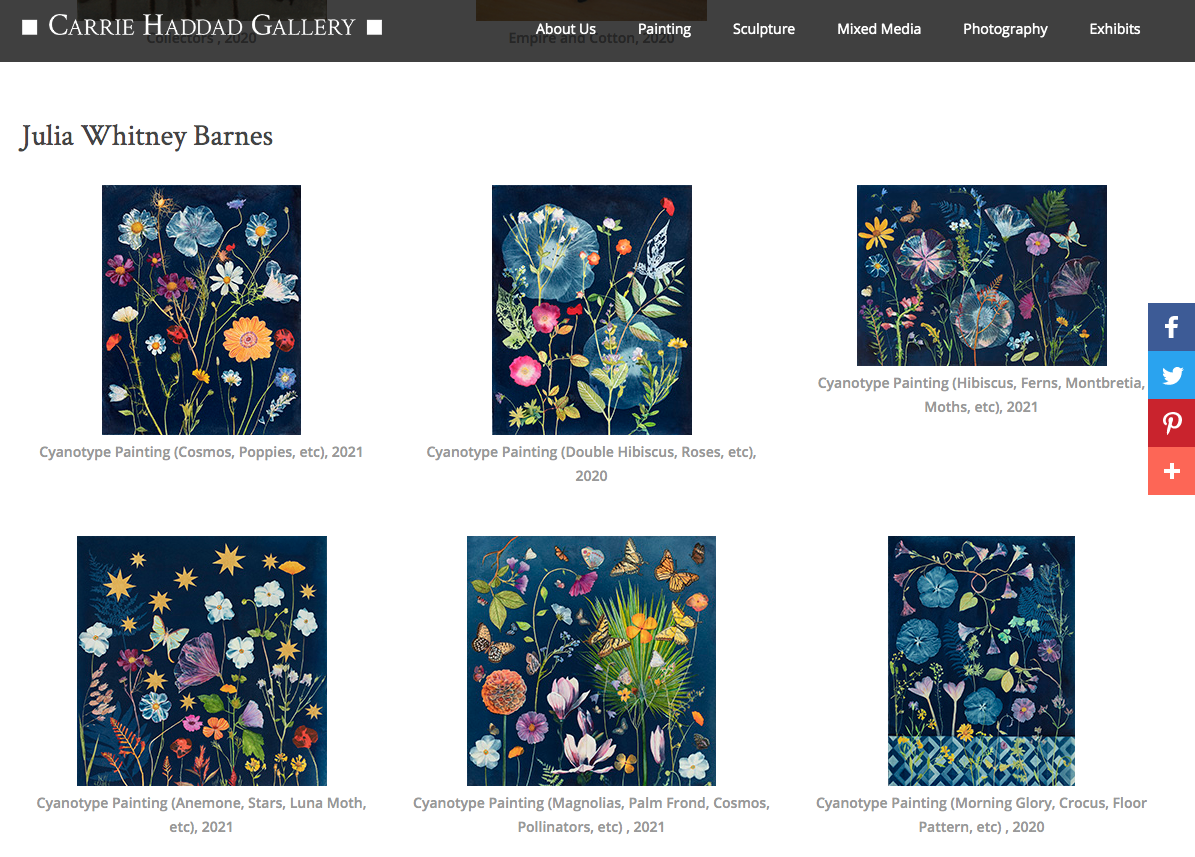
My work is also represented by Carrie Haddad Gallery in Hudson, NY, where I just had a show of a dozen works this spring.
30th Anniversary exhibition at Carrie Haddad Gallery
I am thrilled to have a dozen works at Carrie Haddad Gallery in Hudson, NY to help celebrate the 30th Anniversary of this prestigious gallery. Click here to see my work available through the gallery.
Julia Whitney Barnes, Samantha French, Ruth Geneslaw, Hue Thi Hoffmaster, Nancy Egol Nikkal, Annika Tucksmith, K. Velis Turan, & Judith Wyer
February 17, 2021 through April 11, 2021
Carrie Haddad opened the first art gallery on Warren St. in Hudson, NY in 1991 with a mission to showcase local artists of the region. Thirty years later, that mission remains at the core of the gallery’s operations as we continue to host seven group exhibits a year with a dedicated roster of artists, some of which have shown with Haddad since the beginning. In celebration of the gallery’s 30th anniversary, we are pleased to present an Invitational Exhibit, on view February 17 – April 11, which will highlight our selections from an open call put out at the end of last year. Out of over 200 submissions, 7 artists were chosen: Julia Whitney Barnes, Samantha French, Ruth Geneslaw, Hue Thi Hoffmaster, Nancy Egol Nikkal, Annika Tucksmith, K. Velis Turan and Judith Wyer. Working in a range of media and genres, their work aligns with the variety of creative talent shown at the gallery for three decades. When we consider how dramatically these white walls are transformed every seven weeks, this exhibit will be no exception. Openings are suspended due to Covid-19, but the gallery remains open to the public daily from 11-5 (except Tuesdays are by appointment only).
Carrie Haddad Gallery
622 Warren Street
Hudson, NY 12534
518-828-1915
info@carriehaddadgallery.com
Open Daily: 11 am to 5 pm
Except Tuesdays by appointment only
About the gallery:
Established in 1991 as the first fine art gallery in Hudson, NY, Carrie Haddad Gallery represents professionally committed artists as well as emerging talent specializing in all types of painting, both large and small sculpture, works on paper and a variety of techniques in photography. The majority of our inventory consists of both figurative and non-representational contemporary artwork. Carrie Haddad also represents several estates of deceased artists influenced by the Post War Art Movement in America c.1935 - 1970s.
Occupying 3000 square feet of exhibition space on Warren Street, the gallery is conveniently located just two hours north of Manhattan. The annual exhibition schedule accommodates 7 exhibits on the main floor as well as a rotating selection of photography displayed on the second floor. Carrie Haddad Gallery offers art consultation services, collaborating with design professionals and architects across the country to procure compelling works for private residences and corporate collections. Our diverse inventory offers solutions to fit a variety of criteria and our team ensures direct and dedicated project management.
Video Interview with ArtsBrookfield
Happy to share this interview about Nocturnal Nature, which is on view through March 12th at Brookfield Place in Lower Manhattan.

"Nocturnal Nature" at Brookfield Place

JULIA WHITNEY BARNES: NOCTURNAL NATURE
exhibition
January 11, 2021 - March 12, 2021
8:00 AM - 10:00 PM
Brookfield Place New York (BFPL)
230 Vesey Street
New York, NY 10821
Nocturnal Nature is a new body of work by artist Julia Whitney Barnes that pairs the architectural splendor of the Cesar Pelli-designed windows and atrium of Brookfield Place’s Winter Garden, with inspiration from the space’s interior grove of palm trees, which was designed by Diana Balmori, the late wife of Cesar Pelli. Whitney Barnes’ work—exhibited just off the Winter Garden on the first floor—is composed of a series of framed works on paper that combine watercolor and gouache paintings on cyanotype printed watercolor paper. The imagery depicts botanical arrangements with geometric patterns and the property’s grand atrium windows, revealing various skies alluding to different seasons and times of day. The Washington robusta palm trees planted in the Winter Garden appear to grow right out of the floor, and similarly, Whitney Barnes’ botanicals burst from the implied floor patterns in her artwork. Particularly during these cold winter months, Whitney Barnes’ incorporation of natural elements within her work—sun, flowers, plants, water, and air— brings the promise of spring to this interior hallway, as well as a sense of growth and transformation.
Cyanotype is a camera-less photographic printing process invented in 1842 by scientist and astronomer, Sir John Hirschel, which produces a cyan-blue print when a chemistry-coated surface is exposed to sunlight. Through her use of this medium, Whitney Barnes manipulates physical impressions of plants grown locally in her Hudson Valley home garden and other nearby areas, along with intricately cutout photographic negatives. Each selected flower is preserved through a pressing process in which the artist dissects and shapes each form—akin to a specimen from a natural history museum—and then lays everything out in massive flat files in her attic studio. Given that sunlight starts the exposure process with cyanotype chemistry, the artist carefully arranges elaborate compositions at night and utilizes long exposures under natural or UV light to create the final prints. The digital renderings of the Winter Garden atrium windows and floor that Whitney Barnes designed, were based on an image taken by her husband and professional photographer, Sean Hemmerle. After creating a multi-part negative based on the glazing and metal supports of the atrium’s architecture, Whitney Barnes meticulously painted the exposed watercolor paper with multiple layers of watercolor and gouache. Each cyanotype is created by the power of light, inspiring viewers to look at these very recognizable images in new and different ways.
https://www.artsbrookfield.com/event/julia-whitney-barnes-nocturnal-nature/
https://bfplny.com/event/julia-whitney-barnes-nocturnal-nature/
Cyanotype paintings featured by Strathmore
Pleased to be featured on the Strathmore blog and their article helps illustrate my process in a clear way.
Here’s the link to the full article:
https://www.strathmoreartist.com/blog-reader/cyanotype-watercolor-and-gouache.html

December 23, 2020 | Gouache Mixed Media Watercolor
Cyanotype, Watercolor and Gouache
Artist Julia Whitney Barnes has an absolutely fascinating process for creating her stunning botanical pieces, combining cyanotype, watercolor and gouache.
WHAT IS CYANOTYPE?
Cyanotype is a cameral-ess photographic printing process invented in 1842 by scientist and astronomer Sir John Hirschel, which produces a cyan-blue print when a chemistry-coated surface is exposed to sunlight.
Julia has combined this printing process with fine art to create beautiful botanical masterpieces. Here is a look at her process.
STEPS:
► Julia cuts a roll of our 400 Series Watercolor paper to size. This is a heavyweight paper at 140lb/300gsm and is manufactured to withstand wet media techniques, making it an ideal choice for Julia's process.
► The watercolor paper is coated with cyanotype chemistry, causing it to have a temporary greenish color.
► Julia uses real plants grown locally in her Hudson Valley home garden. Each selected flower is preserved through a pressing process in which she dissects and shapes each form (akin to a specimen from a natural history museum) then lays everything out in massive flat files in her attic studio.
► She meticulously lays out the pressed flowers in an elaborate composition at night.
► The piece is then exposed to natural or UV light to create the cyan-blue print.
► After the cyanotype process is complete and the design is "printed" by exposure to light, she uses a mix of watercolor and gouache to paint the negative areas of the paper, creating her final masterpiece.
Mural highlighted in Apartment Therapy "12 Best Bedrooms We've ever seen"
During the early months of Covid lockdown I decided to transform my daughter’s bedroom with a collaborative work. It was highlighted in Apartment Therapy and then selected as #8 in their top 12 bedrooms, ever.
https://www.apartmenttherapy.com/best-kids-room-makeovers-36841253
Here’s the link to the original article that highlighted the children’s room mural I made with my daughter this spring.
https://www.apartmenttherapy.com/colorful-mural-kids-bedroom-diy-3675746
Before and After: A $36 Project Turns a Plain Bedroom into a Colorful Wonderland
published MAY 27, 2020
Glow in the dark stars used to be the marker of an ultra cool kid’s room, but nowadays these spaces have gotten even cooler—especially when your mom is an artist, like Julia Whitney Barnes. Julia typically works on wall and floor paintings for public and private venues, but this time Julia put her talents to use on her daughter’s bedroom using only materials she already had.
Previously, Julia and her family had been living in Brooklyn, but the need for two art studios and enough space to parent and raise kids led them to head to the Hudson Valley. There, they found a charming 1917 home. They removed the carpet, refinished the wood floors, and painted over the “split pea green” walls. But other than furnishing, they didn’t do much to their young daughter’s room. “Our son was born almost two years ago and they pretty happily share the room now. It is the smallest room in our house, yet so often we find the whole family (including our dog piled) in here,” Julia says. The magnetism of the room was one of a few reasons that it became the perfect candidate for a little makeover.
Because of the pandemic, there was plenty of extra time for art, and an idea that sprung from these creative periods ended up developing into the initial inspiration for the mural. “The walls are all original plaster in here and have a strange texture from their 100 years of life and I wanted to disguise the irregular surface and make the rather small room appear larger by accentuating the high ceilings,” Julia says. “Since the days were all starting to blur together, I was motivated to do something that would have an impact on our daily lives and bring joy to a somber time.”
The project took a week from beginning to end. Julia first did a small collage to plot out the colors and shapes for her mural, then made the painting come to life all on her own. All of the paint came from Julia’s existing inventory, so the only money she spent was on a fresh can of polyurethane sealer—just $36.
Julia used a mix of bold pinks, blues, purples, greens, and yellows from brands like Farrow and Ball, Benjamin Moore, Behr, and Glidden Paints. Following the color, she painted on the polyurethane as a matte top coat to ensure the mural would stay vibrant and last longer. In the closet area, Julia incorporated a chest of drawers with colors that matched those in the mural. A cozy little bed from Sprout Kids in one corner of the room feels like it’s in the middle of a magical garden.
Julia’s mural project totally transformed the basic room, turning the walls into art. “I love how the painting brings new life to the room and our whole family’s life,” Julia says. “It is also really satisfying that it was made with materials just laying around,” says Julia.
Inspired? Submit your own project here.
Melissa Epifano
CONTRIBUTOR
Melissa is a freelance writer who covers home decor, beauty, and fashion. She’s written for MyDomaine, The Spruce, Byrdie, and The Zoe Report. Originally from Oregon, she's currently living in the UK.

Arts Brookfield Commission at One Pierrepont Plaza, Brooklyn Heights
JULIA WHITNEY BARNES: ILLUMINATION
Julia Whitney Barnes
exhibition, installation, visual art
March 9, 2020 - May 1, 2020
8:00 AM - 10:00 PM
One Pierrepont Plaza
300 Cadman Plaza W
Brooklyn, NY 11201
https://www.artsbrookfield.com/event/julia-whitney-barnes-illumination/
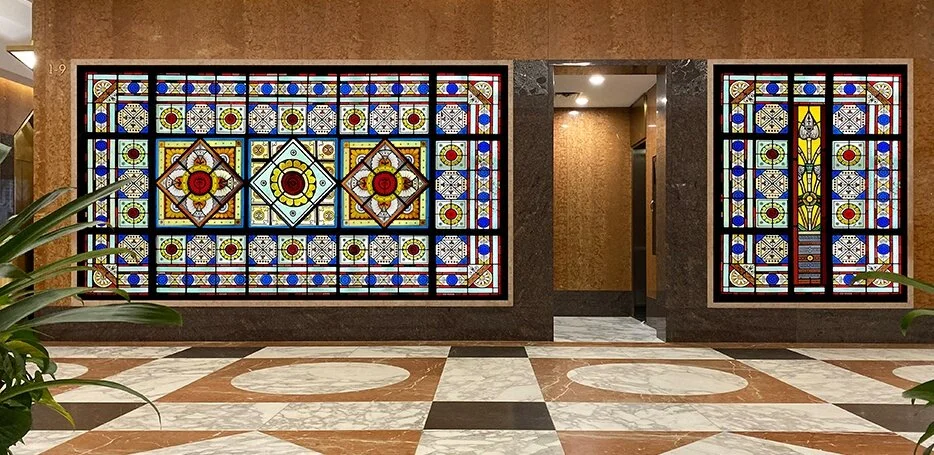
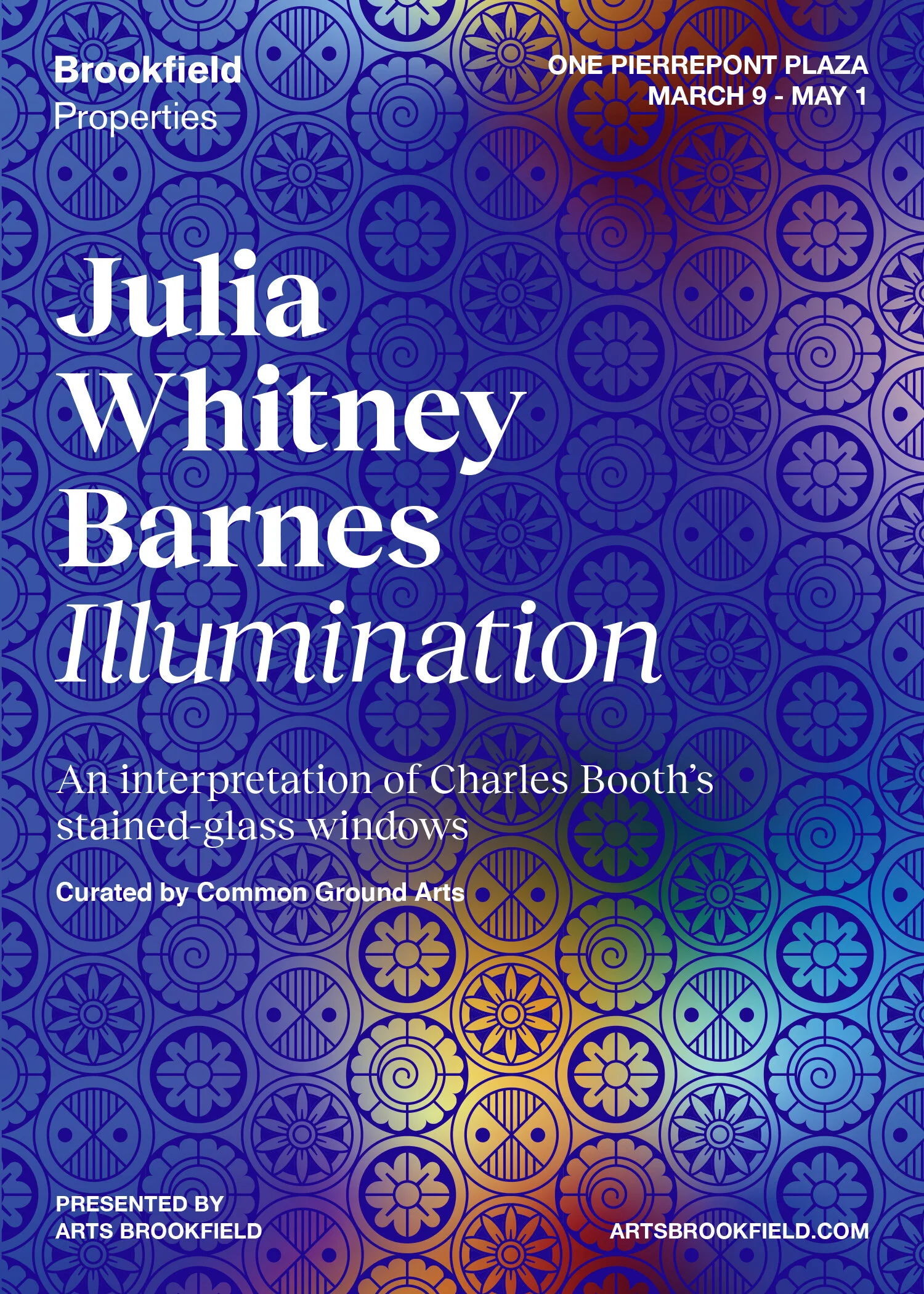
Multi-disciplinary artist Julia Whitney Barnes creates site-specific installations inspired by richly patterned architectural elements of buildings observed firsthand, as well as through collected images and videos. The inspiration for Illumination sparked from experiencing the exquisite stained-glass windows by artist Charles Booth located at the Brooklyn Historical Society, just down the street from One Pierrepont Plaza. Booth was a largely unknown stained-glass artist of the Victorian era, and Whitney Barnes also studied his work at The Jefferson Market branch of the New York Public Library in Lower Manhattan; as well as at Grace Church, Calvary Church, and Trinity Church, all in Manhattan. Whitney Barnes’ deep interest in history brings attention to Booth’s surviving works, while also imagining what some of his now lost windows may have once looked like. For Illumination, she took hundreds of photographs of Booth’s windows from multiple angles and used them as a point of departure for creating her own digital versions, using Booth’s varied themes in new and different ways and adjusting his traditional palette. These new adapted interpretations, have been printed on vinyl and adhered to the marble lobby walls of One Pierrepont Plaza, creating an illusion of illuminated stained-glass windows, and providing a unique opportunity for viewers to see this kind of artwork at eye level.
The artist encourages viewers to visit the Brooklyn Historical Society and Jefferson Market New York Public Library to see the original Booth windows and experience these unique historic buildings. The Brooklyn Historical Society building, designed by George Post in 1878-80, was originally called the Long Island Historical Society. It was one of the earliest buildings in the area to use terra cotta trim. About 90% of George Post’s impressive structures around New York City were demolished to make way for modern skyscrapers. The New York Stock Exchange is one of Post’s most famous structures left intact. A plaque on the exterior of the Jefferson Mark New York Public Library, originally the Jefferson Courthouse building, states “This building, designed along Victorian Gothic Lines by Vaux & Withers, was constructed in 1876 and served as a women’s court until 1932. Of particular interest are its turrets, traceried windows, ironwork and sculpture.” Booth’s windows for the Jefferson Courthouse appear to incorporate imagery that resembles female anatomy, which is fitting.
ABOUT THE ARTIST:
Born in Newbury, VT, Julia Whitney Barnes spent two decades in Brooklyn, before moving to the Hudson Valley, where she now lives with her photographer husband and two children. Whitney Barnes received her BFA from Parsons School of Design and her MFA from Hunter College, both in New York, NY. Her work is executed in a variety of media, from oil paintings, ceramic sculptures, murals, drawings, etchings, and site-specific installations. Whitney Barnes has exhibited in the United States and internationally, including at Front Room Gallery, New York, NY; Brooklyn Historical Society, The Old Stone House, and Trestle Gallery, all Brooklyn, NY; Mattaewan Gallery, Beacon, NY; Cunneen Hackett Arts Center, and WomensWork Gallery, both Poughkeepsie, NY; ArtsWestchester, White Plains, NY Institute of Contemporary Art and International Crytopzoology Museum, both Portland, ME; and Siena Art Institute, Italy, among many others. Whitney Barnes has created site-specific installations at the Wilderstein Sculpture Biennial, Rhinebeck, NY; The Trolley Barn/Fall Kill Creative Works, Poughkeepsie, NY; GlenLily Grounds, Newburgh, NY; ArtsWestchester, White Plains, NY; Gowanus Public Arts Initiative, Brooklyn, NY; Space All Over/Fjellerup Bund i Bund & Grund, Fjellerup, Denmark; Lower Manhattan Cultural Council/Sirovitch Senior Center, and the New York City Department of Transportation, both New York, NY; and Figment Sculpture Garden, Governors Island, NY, among other locations. Her work has been featured in The New York Times, USA Today, The Village Voice, Brooklyn Magazine, HuffPost, and Hyperallergic, among other publications. She was awarded fellowships from New York State Council on the Arts administered through Arts Mid-Hudson, Lower Manhattan Cultural Council, and the Gowanus Public Art Initiative. She is on faculty at Marist College in Poughkeepsie, NY. Learn more at juliawhitneybarnes.com and follow the artist on Instagram at @juliawhitneybarnes.
ABOUT CHARLES BOOTH (1844-1893)
Born in Liverpool, England, he was first listed in the NYC directories as “stainer” (stained-glass artist) in the 1875-76 publication. He lived in Orange, NJ and had workshops at 166 Fifth Avenue and then 47 Lafayette Place in Manhattan. Booth’s time in NYC was quite brief as he returned to London, England in 1880 to take over George Edward Cook’s studio while still maintaining a NYC branch of his operations. Cook was best known as a painter, primarily working in stained glass during the 1870s with an emphasis of elements in a Japanese style. Booth was part of the Aesthetic Movement and considered himself to be an ornamentalist working in an Anglo-Japanese style that was popularized in the 1870s by Charles Dresser. His style incorporated some recognizable Modern Gothic motifs and geometricized plant forms. Although Booth died in 1893, the last listing for his studio in NYC was 1905/06. According to his will, made in 1884, Booth desired “that his business be carried on in England and America,” and thus the workshop continued to operate under his name even after his death. How fitting that over 125 years after his passing, his legacy will be reinvigorated with a new creation in his honor.